Web Development • AI • Performance
Vinext: How Cloudflare Rebuilt Next.js with AI in One Week for $1,100
In February 2026, Cloudflare released Vinext—a drop-in replacement for Next.js that builds 4.4x faster and ships 57% smaller bundles. The story behind it is more remarkable than the tool itself: one engineer and Claude AI built the entire framework in seven days for roughly $1,100 in API tokens. Here's the complete story of what Vinext is, why it matters, and what it means for the future of web development.
Author: Wilson Kumalo
Category: Web Development & AI
Reading time: 10 minutes
Published: February 25, 2026
The Framework That Shouldn't Exist
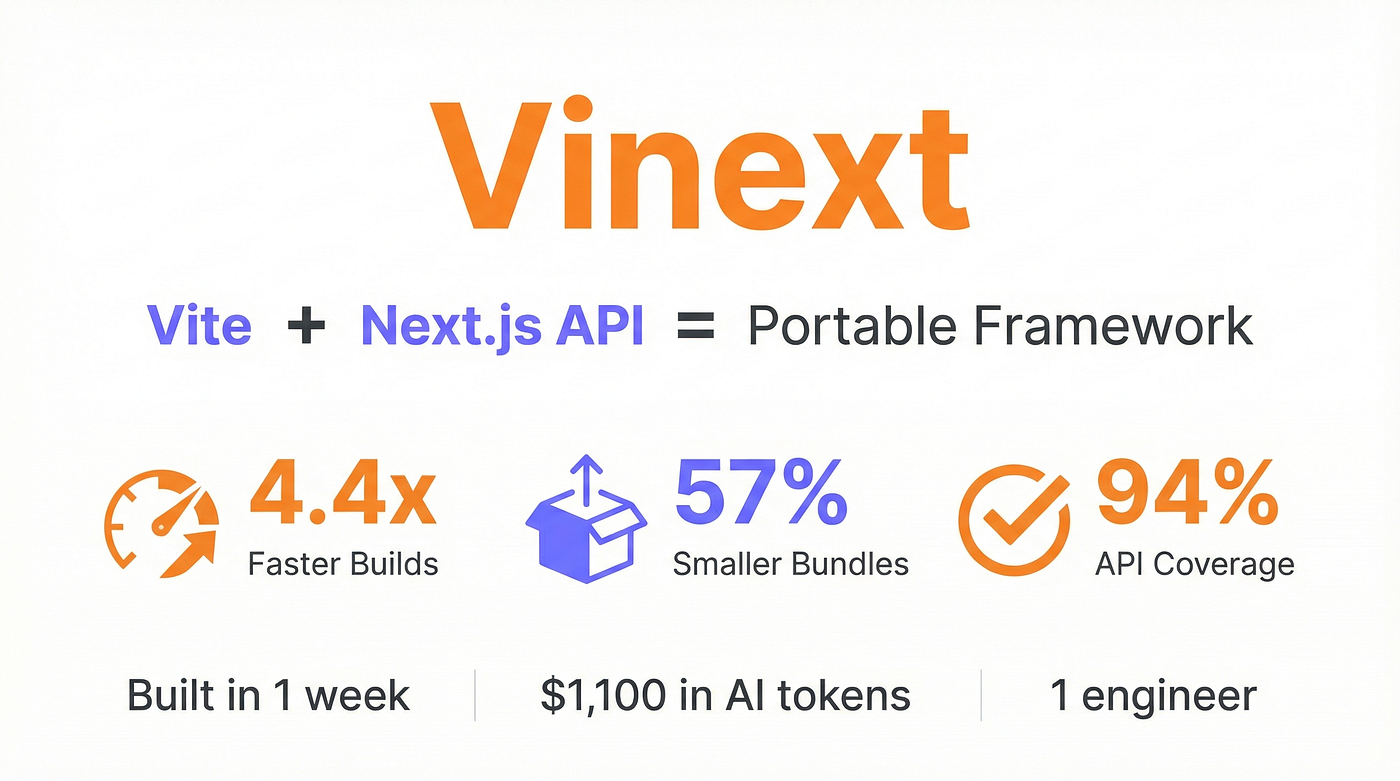
On February 24, 2026, Cloudflare published a blog post with a headline that stopped the web development world cold: "How we rebuilt Next.js with AI in one week."
The result is Vinext (pronounced "vee-next")—a complete reimplementation of the Next.js API surface built on Vite, deployable to Cloudflare Workers with a single command, and already running production sites like CIO.gov.
The numbers alone are impressive:
- 4.4x faster production builds (with Vite 8/Rolldown)
- 57% smaller client bundles
- 94% API coverage of Next.js 16
- 1,700+ unit tests and 380 E2E tests
- Already in production on government websites
But the development story is what makes this unprecedented: one engineer directing Claude AI across 800+ coding sessions, built in seven days, for approximately $1,100 in API tokens.
This isn't a toy demo. This is a production-grade reimplementation of the most popular React framework—built by AI with human direction.
What Is Vinext? (And What It Isn't)
Let's be precise about what Vinext actually is.
Vinext IS:
- A Vite plugin that reimplements the public Next.js API
- A drop-in replacement for Next.js—your existing
app/,pages/, andnext.config.jswork as-is - Compatible with App Router, Pages Router, middleware, Server Actions, React Server Components
- Deployable to Cloudflare Workers (and potentially other platforms) with a single command
- Built on Vite's proven build toolchain instead of Turbopack
Vinext is NOT:
- A fork of Next.js
- A wrapper around Next.js output (that's OpenNext's approach)
- Limited to Cloudflare—the Vite Environment API makes it platform-agnostic
- Production-ready for critical workloads (it's experimental, less than two weeks old)
The critical distinction: OpenNext reverse-engineers Next.js build output and reshapes it. Vinext replaces the build toolchain entirely.
Installation and Usage
# Install
npm install vinext

# Replace "next" with "vinext" in package.json scripts
# Everything else stays the same

# Commands
vinext dev          # Development server with HMR
vinext build        # Production build
vinext deploy       # Build and deploy to Cloudflare Workers
The Performance Numbers That Matter
Cloudflare benchmarked Vinext against Next.js 16 using a 33-route App Router application. Both frameworks compiled, bundled, and prepared server-rendered routes. They disabled TypeScript checking and ESLint in Next.js to measure only bundler speed.
Production Build Time
| Framework | Mean Build Time | vs Next.js |
|---|---|---|
| Next.js 16.1.6 (Turbopack) | 7.38s | Baseline |
| Vinext (Vite 7 / Rollup) | 4.64s | 1.6x faster |
| Vinext (Vite 8 / Rolldown) | 1.67s | 4.4x faster |
Client Bundle Size (Gzipped)
| Framework | Gzipped Size | vs Next.js |
|---|---|---|
| Next.js 16.1.6 | 168.9 KB | Baseline |
| Vinext (Rollup) | 74.0 KB | 56% smaller |
| Vinext (Rolldown) | 72.9 KB | 57% smaller |
Why This Matters
A 57% reduction in bundle size directly impacts:
- Core Web Vitals: Faster First Contentful Paint and Largest Contentful Paint
- SEO rankings: Google explicitly uses page speed as a ranking factor
- Mobile performance: Critical for users on slower connections
- Conversion rates: Every 100ms of load time impacts user behavior
For a content-heavy site, this is the difference between "good" and "excellent" PageSpeed scores.
The Problem Vinext Solves: Why OpenNext Exists
To understand Vinext, you need to understand the problem it solves.
Next.js is the most popular React framework, powering millions of production sites. But it has a deployment problem: the tooling is entirely bespoke. Next.js uses Turbopack for builds, and if you want to deploy to Cloudflare Workers, Netlify, or AWS Lambda, you have to reshape that build output into something those platforms can run.
That's what OpenNext does. Multiple providers (including Cloudflare) have contributed significant engineering effort to OpenNext. It works, but it's fragile.
The Fragility Problem
As Cloudflare explains:
"Building on top of Next.js output as a foundation has proven to be a difficult and fragile approach. Because OpenNext has to reverse-engineer Next.js's build output, this results in unpredictable changes between versions that take a lot of work to correct."
Every Next.js minor release can break OpenNext compatibility because Vercel doesn't guarantee the stability of internal build artifacts. OpenNext maintainers spend significant time playing catch-up after each Next.js update.
Vinext eliminates this problem by reimplementing the public API (which is stable and documented) rather than adapting the internal build output (which changes unpredictably).
The AI Development Story: $1,100 and Seven Days
The most remarkable aspect of Vinext is how it was built.
The Numbers
- Timeline: 7 days (February 13-19, 2026)
- Team size: 1 engineer (Steve Faulkner)
- AI sessions: 800+ with Claude
- Total cost: ~$1,100 in API tokens
- Lines of code: Almost entirely AI-generated
- Test coverage: 1,700+ unit tests, 380 E2E tests
Day-by-Day Progress
| Day | Achievement |
|---|---|
| Day 1 (Feb 13) | Pages Router + App Router SSR working, middleware, server actions, streaming |
| Day 2 (Feb 14) | 10 of 11 App Router Playground routes rendering correctly |
| Day 3 (Feb 15) | vinext deploy shipping apps to Cloudflare Workers with full client hydration |
| Days 4-7 | Hardening: fixing edge cases, expanding test suite, bringing API coverage to 94% |
The Development Process
According to Steve Faulkner's blog post, the workflow was straightforward:
- Define architecture — Spent 2 hours with Claude planning the implementation strategy
- Define tasks — Break down features ("implement the
next/navigationshim") - Let AI implement — Claude writes the code and tests
- Run test suite — Automated verification
- Iterate if needed — If tests fail, give AI the error output
- Merge and repeat
AI agents handled code review too. When PRs opened, an agent reviewed them. When review comments came back, another agent addressed them.
Quality Gates
This wasn't "vibe coding." Vinext enforces rigorous quality standards:
- 1,700+ Vitest unit tests
- 380 Playwright E2E tests (many ported from Next.js's own suite)
- Full TypeScript type checking
- Oxlint linting
- CI/CD on every pull request
- Browser-level testing via agent-browser
As Faulkner notes: "Almost every line of code in vinext was written by AI. But here's the thing that matters more: every line passes the same quality gates you'd expect from human-written code."
Why AI Succeeded Here (When It Usually Doesn't)
Not every project would work this way. Four factors aligned perfectly:
1. Well-Documented Target
Next.js has extensive documentation, millions of users, and years of Stack Overflow answers. The API surface is thoroughly covered in training data. When Claude implements getServerSideProps or useRouter, it doesn't hallucinate—it knows how Next.js works.
2. Executable Specification
The Next.js repository contains thousands of E2E tests covering every feature. Vinext ported tests directly from that suite, providing a mechanical way to verify correctness.
3. Solid Foundation
Vite handles the hard parts: fast HMR, native ESM, clean plugin API, production bundling. Vinext didn't have to build a bundler—just teach Vite to speak Next.js.
4. Model Capability
Earlier models couldn't sustain coherence across a codebase this size. Claude can hold the full architecture in context, reason about module interactions, and produce correct code often enough to maintain momentum.
As Cloudflare states: "We don't think this would have been possible even a few months ago."
What Vinext Supports (And Doesn't)
Fully Supported Features
- App Router — Full support
- Pages Router — Full support
- Middleware — Full support
- Server Actions — Full support
- React Server Components — Full support
- Streaming SSR — Full support
- Client-side hydration — Full support
- Incremental Static Regeneration (ISR) — Via Cloudflare KV
- Platform bindings — Durable Objects, KV, AI, R2 (no workarounds needed)
Not Yet Supported
- Static pre-rendering at build time — On the roadmap
- generateStaticParams() — Build-time static generation not implemented
- 6% of Next.js API surface — Edge cases and less common features
Experimental: Traffic-Aware Pre-Rendering
This is Vinext's most innovative feature.
Traditional Next.js pre-renders every page listed in generateStaticParams() at build time. A 10,000-product site means 10,000 renders during the build—even if 99% never receive traffic.
Traffic-aware Pre-Rendering (TPR) queries Cloudflare's zone analytics at deploy time and pre-renders only pages that actually get visited.
vinext deploy --experimental-tpr

  TPR: Analyzing traffic for my-store.com (last 24h)
  TPR: 12,847 unique paths — 184 pages cover 90% of traffic
  TPR: Pre-rendering 184 pages in 8.3s → KV cache
For a 100,000-page site, the power law means 90% of traffic goes to 50-200 pages. Those get pre-rendered in seconds. Everything else falls back to on-demand SSR.
Already Running in Production
Vinext isn't just a demo. It's already running production workloads.
CIO.gov
Cloudflare worked with National Design Studio—a team modernizing government interfaces—on one of their beta sites, CIO.gov. They're running Vinext in production with measurable improvements:
- Faster build times
- Smaller bundle sizes
- Better Core Web Vitals
Live Examples
Cloudflare has several live demos running on Workers:
What This Means for Software Development
Vinext is a data point in a much larger story.
The Abstraction Question
Cloudflare's blog post poses a profound question:
"Why do we have so many layers in the stack? Most abstractions in software exist because humans need help. We couldn't hold the whole system in our heads, so we built layers to manage complexity. AI doesn't have the same limitation. It can hold the whole system in context and just write the code."
The implication: many abstractions we've built over decades were crutches for human cognition, not fundamental necessities.
AI can take an API contract, a build tool, and just write everything in between. No intermediate framework needed.
The Connection to Dario Amodei's Prediction
This connects directly to Anthropic CEO Dario Amodei's warning at Davos that AI could handle "most, maybe all" software engineering within 6-12 months.
Vinext is evidence: one engineer and Claude rebuilt an entire framework in a week. The Anthropic Cowork product was built in 1.5 weeks almost entirely with AI. PicoClaw was self-bootstrapped—an AI agent rewrote itself from Python to Go.
The pattern is clear: AI is moving from "helpful assistant" to "primary implementer."
OpenNext vs. Vinext: Which Should You Use?
| Factor | OpenNext | Vinext |
|---|---|---|
| Maturity | Production-ready | Experimental (< 2 weeks old) |
| Approach | Adapts Next.js output | Reimplements API on Vite |
| Stability | Breaks with Next.js internals | Stable against public API |
| Build Speed | Standard | 1.6–4.4x faster |
| Bundle Size | Standard | 57% smaller |
| Platform Support | AWS, Cloudflare, Netlify, etc. | Cloudflare-first, others possible |
Recommendation
Today: Use OpenNext for production workloads. It's battle-tested and stable.
Near future: Start experimenting with Vinext on non-critical projects. Monitor its development.
6-12 months: When Vinext reaches 1.0, the performance advantages (4.4x faster builds, 57% smaller bundles) will be hard to ignore.
How to Try Vinext Today
New Project
npm create vinext@latest my-app
cd my-app
npx vinext dev
Migrate Existing Project
npx vinext init
# Update package.json: replace "next" with "vinext" in scripts
npx vinext dev
Agent-Assisted Migration
npx skills add cloudflare/vinext
# Then in your AI coding tool (Cursor, Claude Code, etc.):
# "migrate this project to vinext"
Deploy to Cloudflare Workers
npx vinext deploy
One command. That's it.
Conclusion: A Proof Point for AI-Native Development
Vinext matters for three reasons:
1. It's a Production-Grade Framework
This isn't a demo. It's 94% API-compatible with Next.js 16, has 2,000+ tests, and is already running government websites. The quality is real.
2. It Validates AI-Assisted Development
One engineer and Claude rebuilt an entire framework in a week. With proper quality gates (tests, type checking, linting, CI/CD), AI-generated code reaches production quality.
3. It Challenges Assumptions About Abstractions
How many layers in our software stack exist because humans needed cognitive crutches? AI doesn't need those crutches. Which abstractions are truly foundational, and which were just workarounds for human limitations?
That question will reshape software development over the next few years.
The Bigger Picture
Vinext is part of a pattern:
- PicoClaw — AI rewrote itself from Python to Go in a day
- Anthropic Cowork — Built in 1.5 weeks almost entirely with AI
- Dario Amodei's prediction — "Most, maybe all" software engineering automated in 6-12 months
- Vinext — A complete framework reimplementation in one week
The trend is unmistakable: AI is transitioning from assistant to primary implementer.
Vinext is experimental today. But watch this space. When it reaches 1.0, those performance numbers (4.4x faster, 57% smaller) will be hard to ignore.
And the fact that it was built by AI in a week? That's the real story.